
Is Kukatpally a City or Town?
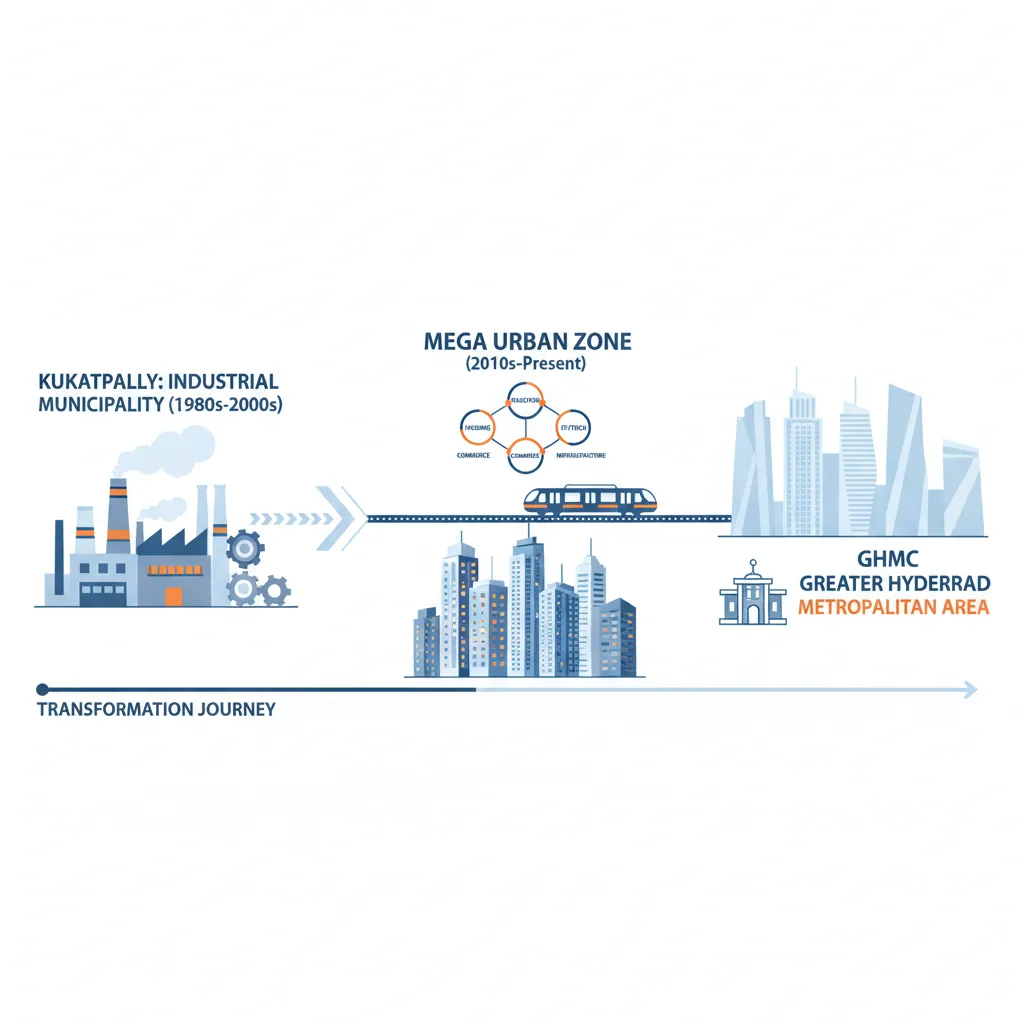
Administratively, Kukatpally is neither an independent city nor a standalone town. Instead, it is a major neighborhood and a primary commercial-residential zone within the Greater Hyderabad Municipal Corporation (GHMC).
Once a busy industrial municipality on the outskirts of Hyderabad, Kukatpally officially merged into the GHMC in 2007. Today, it serves as the headquarters for the massive Kukatpally Zone. Because of its dense population, self-reliant economy, and massive infrastructure—like its own metro line and major shopping hubs—it functions as a self-sustaining "city-within-a-city" rather than a traditional town.
From Industrial Town to Mega Urban Zone
Kukatpally's growth shows how a small, peripheral area can transform into a major economic hub.
1. Before 2007: The Independent Municipality
Before joining the larger municipal corporation, Kukatpally was run as an independent municipality. It was heavily driven by the Kukatpally Industrial Area and nearby industrial spots like Sanathnagar and Balanagar. During this time, it was mostly viewed as an industrial township.
2. The Big Merger and the Tech Boom
Everything changed in 2007 when the government expanded the city limits. It merged 12 municipalities—including Kukatpally—to create the Greater Hyderabad Municipal Corporation (GHMC). This administrative change happened right as the nearby IT corridors (HITEC City and Gachibowli) began to boom. The close distance quickly turned Kukatpally into the favorite residential hub for the city's tech workforce.
The Scale of Kukatpally: A Massive Zone
To understand why people struggle to classify it as just a town or city, look at the scale of the Kukatpally Zone. Within the GHMC setup, this zone is huge and manages five distinct administrative circles:
- Moosapet (Circle 21)
- Kukatpally (Circle 22)
- Quthbullapur (Circle 23)
- Gajularamaram (Circle 24)
- Alwal (Circle 25)
With a population running into hundreds of thousands and home to KPHB Colony (one of the largest residential layouts in Asia), Kukatpally's population density and economic power easily beat out many Tier-2 and Tier-3 cities in India.
Real Estate Benefits of Its Municipal Status
For property buyers, being part of the GHMC gives Kukatpally major structural perks that standalone towns rarely get:
- Connected Infrastructure: Kukatpally is fully tied into Hyderabad's main civic networks. This means reliable water pipelines from the Krishna and Godavari rivers, a dedicated metro network with three major stations, and flyovers linking directly to the Financial District.
- High-Rise Growth: Because it follows GHMC rules, developers can use premium Floor Space Index (FSI) regulations to build upward. This has brought a wave of luxury high-rise communities to the area, a type of skyscraper growth usually found only in major Tier-1 cities.
Case Study: Godrej Brooklyn Avenue
The shift of Kukatpally from a suburban town to a hyper-urban city zone is perfectly captured by the launch of Godrej Brooklyn Avenue.
Spread across a 7.7-acre land parcel in KPHB Phase IV, this New York-themed gated community represents the exact kind of dense, vertical development that only a core metropolitan GHMC zone can support.
Sky-High Planning Over Simple Town Layouts
In traditional towns, building heights are strictly limited by basic local roads and utility caps. Godrej Brooklyn Avenue, however, features two iconic twin towers rising up to G+45 floors. Building vertically allows the project to keep 70% to 75% of the land as open green spaces, offering a balanced environment right in the middle of a crowded commercial zone.
Premium Lifestyle Features
While a standalone town relies on scattered local markets, a "city-within-a-city" builds complete lifestyle spaces inside its own gates. The project features a massive 72,000 sq. ft. multi-level clubhouse that offers panoramic views of the HITEC City skyline.
Located just minutes from the JNTU College Metro Station, Godrej Brooklyn Avenue stands as clear proof that Kukatpally has outgrown its old "town" status to become a premier luxury hub of metropolitan Hyderabad.
![]() Frequently Asked Questions
Frequently Asked Questions

No, Kukatpally is not a separate city. It is a major neighborhood and administrative zone in the northwestern part of Hyderabad, fully governed by the Greater Hyderabad Municipal Corporation (GHMC).
Yes. Before April 2007, Kukatpally was an independent municipality with its own local governing body. It was then merged with Hyderabad and 11 other areas to form Greater Hyderabad.
Today, Kukatpally is officially classified as a Zone within the GHMC. It is led by a Zonal Commissioner and split into five administrative circles to manage its large daily civic operations.
No, Kukatpally does not have an independent municipality. All property registrations, building plan approvals, and property taxes go through the GHMC. All real estate projects are regulated under TS-RERA (Telangana Real Estate Regulatory Authority).
It earned this nickname due to its massive scale. It has a very high population density, independent commercial markets, major malls like Lulu and Nexus Forum, top-tier hospitals, and corporate offices. Residents rarely need to leave the area for their daily or luxury needs.
The merger boosted property values significantly. It brought integrated municipal infrastructure, better water connectivity, wider roads, and major transport links like the Hyderabad Metro. This changed it from a modest suburb into a premium real estate zone commanding upwards of ₹11,000 per square foot.
While Kukatpally is a core part of the Hyderabad metropolitan area under the GHMC's urban jurisdiction, it geographically falls within the Medchal-Malkajgiri district of Telangana.